Big Muhly
Muhlenbergia lindheimeri
FAMILY: Poaceae (Grass Family)A resilient evergreen native Texas grass & sedge that provides year-round foliage and structure to the landscape. Native across the Edwards Plateau, Southern Texas Plains, and Texas Blackland Prairies, Big Muhly (Muhlenbergia lindheimeri) thrives in local conditions while supporting the surrounding ecosystem. Distinguished by dark foliage that is upper surface a glossy light to dark green, grayish- green beneath with dense pubescent bloom that rubs off, it offers an exceptional visual and tactile texture. During spring, summer, and fall, the plant produces white flower clusters. Flowering is followed by acorns annual; peduncle 1⁄8 - 11⁄8 inches (3 - 29 mm) supporting 1 - 5 nuts, cup has narrow base, light gray scales with reddish-tips may be smooth or pubescent encloses 1⁄4 - 1⁄2 of nut; dark brown, narrow and oblong nut with light brown stripes, 5⁄8 - 1 inch (16 - 25 mm) long that add vibrant visual contrast and seasonal interest. It plays a vital ecological role as a larval host plant for Central Texas butterflies, including Horace's Duskywing. It provides cover and nesting sites for birds and small mammals. Its acorns feed birds and mammals. Thriving in calcareous, rocky, sand, and well drained, Big Muhly demonstrates outstanding hardiness once established. It requires minimal supplemental water and adapts seamlessly to drought conditions.
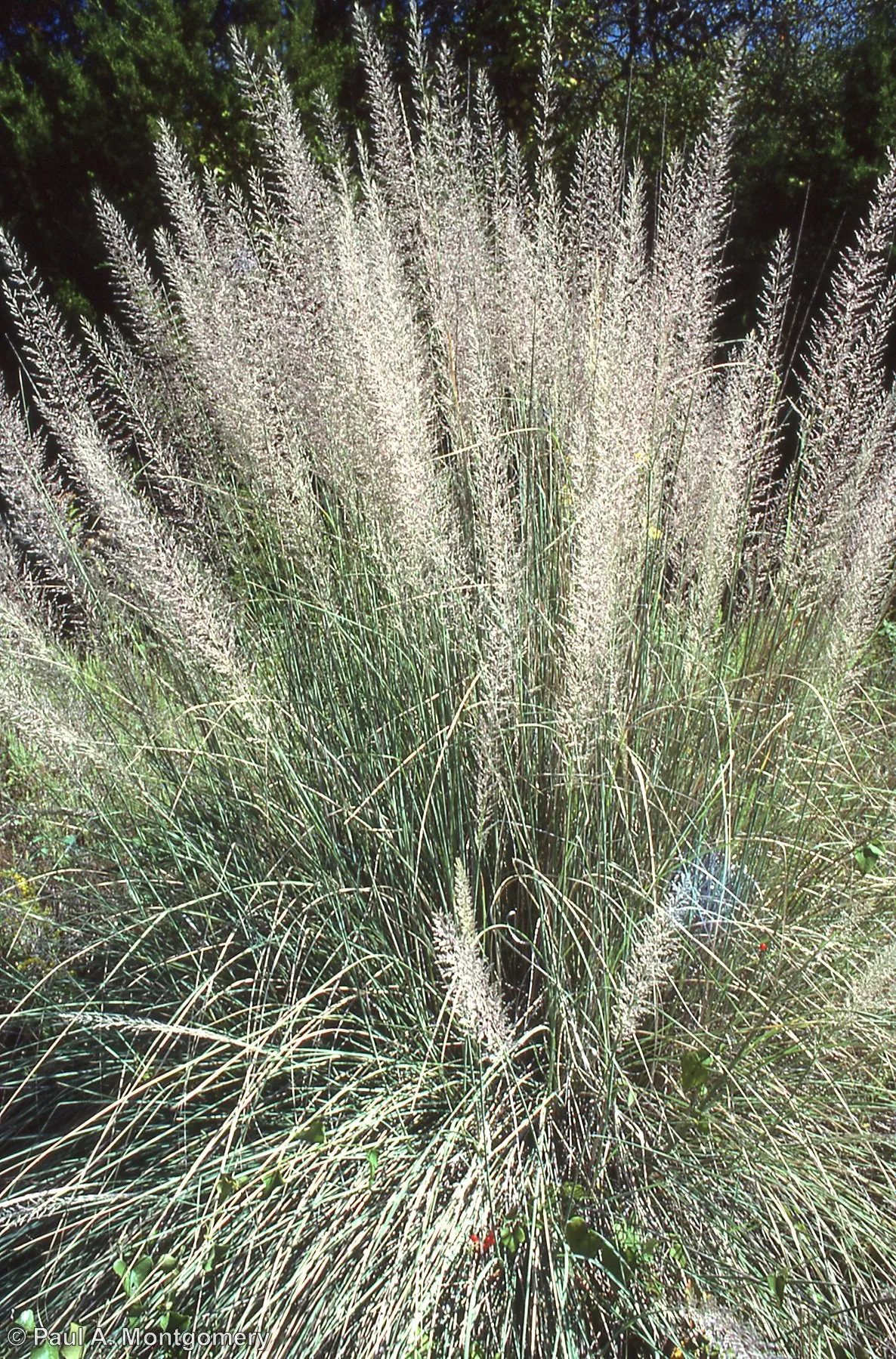
Big Muhly
Muhlenbergia lindheimeri
Texas Native Ecoregions9 REGIONS
Edwards Plateau, Southern Texas Plains, Texas Blackland Prairies
3 ft.
1 ft.
Semi Evergreen
Larval food plant for: Horace's Duskywing
Larval host plant for Central Texas butterflies: Horace's Duskywing. Verified online via Lady Bird Johnson Wildflower Center. Verified via Texas Entomology (Mike Quinn, texasento.net) and Lady Bird Johnson Wildflower Center (wildflower.org).
Non-toxic to humans, birds, and domestic animals.
Low maintenance once established.